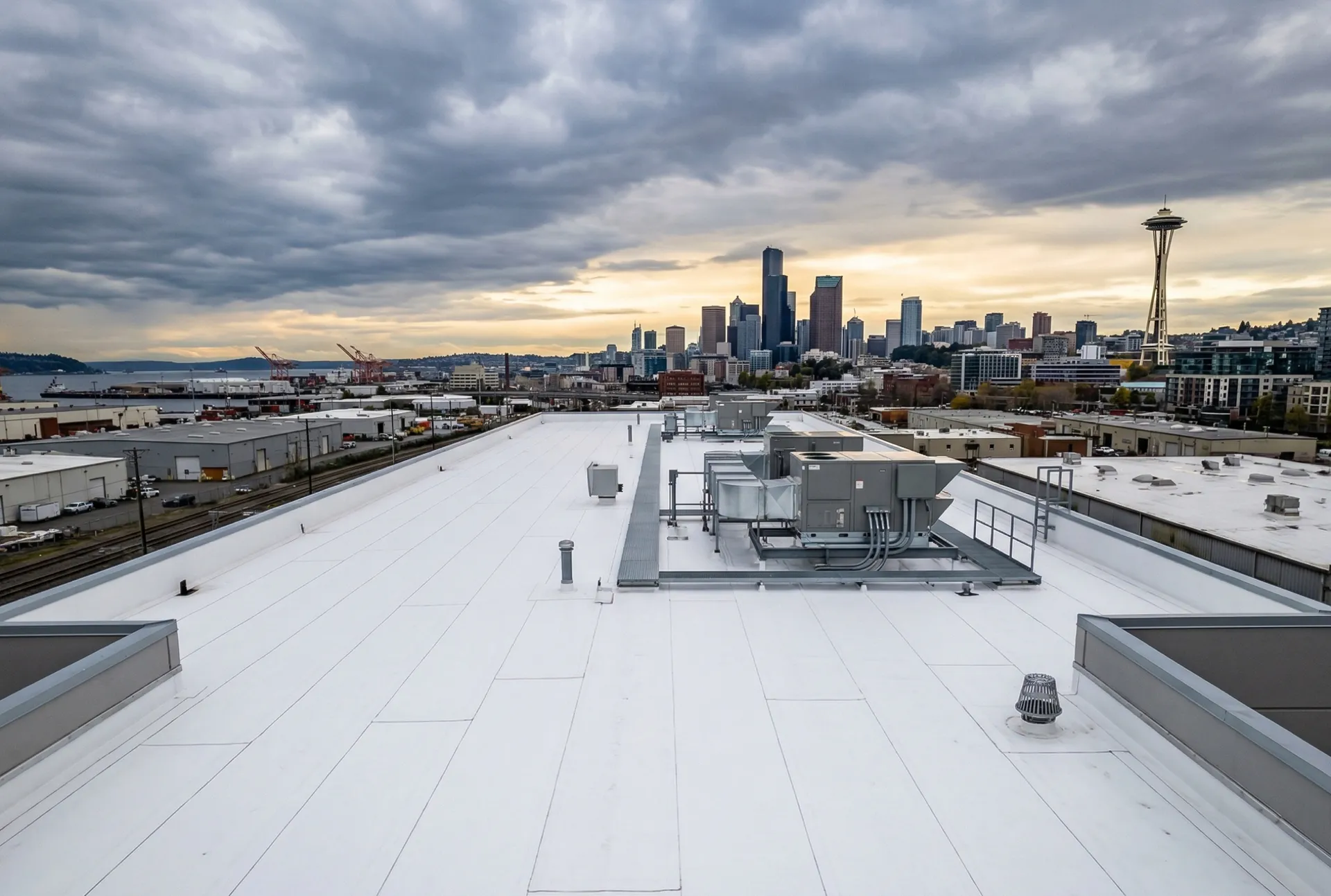
Flat Roofs.Built for Seattle Rain.
TPO, PVC, EPDM, and modified bitumen for office buildings, retail, multi-family, restaurants, and warehouses across King, Snohomish, and Pierce counties. NDL manufacturer warranties, full insurance, prevailing-wage capable, and crews that understand atmospheric river rain.
The 4 Commercial Roofing Systems, Plain English
Property managers who get this right save 5–10 years of headaches. Here's what each system actually is, what it costs, and what it's good for in Western Washington.
TPO
White single-ply membrane with heat-welded seams. Reflective, durable, and the most common commercial choice in Seattle. The white surface meets WSEC cool-roof provisions on certain occupancies.
- Heat-welded seams = monolithic membrane
- Reflective white surface (energy savings)
- 20–25 yr manufacturer NDL warranties available
- Resistant to UV, punctures, and chemicals
PVC
Single-ply membrane that handles grease, chemicals, and high heat better than any other system. The right call for restaurants, kitchens, and chemical exposure.
- Superior chemical and grease resistance
- Heat-welded seams (like TPO)
- Fire-resistant
- Longest lifespan of the single-ply systems
EPDM
Black synthetic rubber single-ply, the original 'rubber roof.' Long track record but the seams are taped or glued, and over 15+ years EPDM tends to shrink and pull at flashings.
- Lowest installed cost of the single-ply systems
- Long real-world track record (since the 1960s)
- Easy to repair with patches
- Stretchable — handles building movement
Modified Bitumen
Asphalt-based, multi-ply, applied with torch or cold-set adhesive. Heavy and redundant. Note: torch-applied work is restricted on some Seattle jobs (fire risk).
- Multiple plies = built-in waterproofing redundancy
- Walkable / heavy traffic resistant
- Familiar to older building owners
- Good for warehouse and industrial roofs
Cost ranges are 2026 industry survey averages. Final pricing depends on tear-off, insulation R-value, deck condition, parapet detailing, and access.
What Actually Wrecks Seattle Commercial Roofs
These aren't textbook problems — these are the failures we see week after week on real Puget Sound buildings. Knowing them is half the battle.
Ponding Water
Seattle's sustained rain finds any negative slope or blocked drain. Water sitting on the membrane more than 48 hours voids most manufacturer warranties. Clogged interior drains and scuppers are the #1 leak cause we see in this market.
Moss & Algae
PNW humidity + shaded north sides + adjacent trees = aggressive biological growth. Moss roots penetrate seams and lift flashings. We recommend quarterly inspection and cleaning on every Seattle commercial roof.
EPDM Seam Shrinkage
EPDM shrinks over time, pulling at seams, flashings, and parapet terminations — the single most common failure mode for aging Seattle EPDM roofs. If your building has 15+ year old EPDM, it's on borrowed time.
Flashing & Penetration Failures
HVAC curbs, pipe boots, skylight curbs, and parapet terminations are where almost every leak starts. We pressure-wash, photograph, and re-seal all penetrations as part of every install.
What to Demand From Every Commercial Roofing Bid
If you're putting your roof out to bid, here's the property manager's checklist. Any contractor who can't check every box on this list is a contractor you can't afford.
NDL warranty
No Dollar Limit labor + material — the gold standard. Material-only warranties leave you on the hook for the labor when something fails.
Insurance certificates
GL ≥ $2M, WA L&I workers' comp, auto. Additional insured endorsement for the building owner.
Tear-off vs re-cover
Seattle code allows up to 2 roofing layers on most commercial buildings. Re-cover is faster and cheaper but only works once and only over a sound substrate.
Tenant disruption plan
Noise, odor, parking, dumpster placement, hours of operation. We coordinate with your tenants before day 1.
Prevailing wage
Required only on WA public works (no dollar threshold per RCW 39.12). Private commercial is not subject unless public funds are involved.
References
Comparable building type, similar square footage, local. Ask for 3 we did in the last 12 months — we'll give you 5.
Why Seattle Property Managers Hire Stark
30+ years installing commercial flat systems in Western Washington — we've seen what fails and we know exactly how to install around it.
Extended Lifespan
20–30+ year systems with NDL manufacturer warranties. We do the install the way the manufacturer specs it — no shortcuts that void coverage.
Minimal Downtime
We coordinate with your tenants on day 1, work in dry weather windows, and never block tenant access. Daily written schedule before we start.
Full Compliance
$2M general liability, WA L&I workers' comp, additional insured endorsements at no charge, and prevailing-wage capable for public works.
Commercial Roofing FAQ
Real answers to the questions Seattle property managers ask before hiring a commercial roofing contractor.
Get Your Free Quote
Pick a service and a time — we'll confirm by text.
Get Your Free Quote
Same-day reply. No pressure, no obligation.
Prefer to talk? Call (206) 739-8232